Market Signals
Beyond the Discount: What Competitor Promotions Really Tell Us About Business Strategy
October 29, 2026


Almost anyone can publish polished content now. With a laptop and a subscription, you can produce an article, a script, and a video in an afternoon, with or without showing your face. The output looks finished, and it often reads well.
I think we owe AI some thanks for that. It leveled the playing field for content, and in doing so it pointed out something so obvious that it is easy to overlook. The one thing artificial intelligence cannot produce is its opposite: the authentic, the real, a person thinking in the moment.
When finished output becomes cheap, the finished piece stops telling us much about the person behind it. What everyone can do has rarely been what people value most. That held when everyone could start a business, and it holds now that everyone can publish.
AI lowered the barrier to producing content. For most people, it has not made them more distinct. The signal moves somewhere else, and I think it moves to the moments where a person has to respond in real time, without the edit.
Going live asks for exactly that. You show up, someone asks a question you did not prepare for, and the audience watches how you find your way through it.
A generative system can draft your talking points. It cannot stand in front of people and orient itself as you, in that moment, with your lived experience behind the answer.
Real-time presence shows your judgment while it is still forming. A produced piece shows only the conclusion.
I first noticed this as a small, early shift in my own work with clients. Research and conversations with others since then have confirmed it.
I want to be clear about the scope of this argument. Produced content, AI-assisted content, and live sessions each serve a purpose, and the right mix depends on your work, your audience, and what feels true to you. Not everyone should go live, just as not everyone is a gifted writer.
Find the way of expressing yourself that suits you, and feel free to develop new ones. What I do hold firmly is that human-to-human connection has no substitute. Going live is one way to offer it.
A workshop, a client conversation, or a podcast recorded as a real dialogue can offer it too.
When I encourage clients to go live, the hesitation they describe tends to come down to control.
Recorded content protects you. You can pause, start again, and remove the stumble. You choose exactly what people get to see.
Going live removes that protection. You respond in the moment, and you cannot always predict how you will come across.
The fear rarely concerns visibility itself. They already publish. The fear concerns being visible without the edit: losing a train of thought, giving an imperfect answer, sitting in a silence they did not plan.
That moment feels dangerous. It rarely is.
In my work with clients, in dance, in trauma recovery, and in business coaching, the small stumble often makes the conversation more honest. Someone starts a sentence again, and when I give them room instead of smoothing it over, they stop delivering the polished version and start working with what is actually there.
The connection deepens at that point, because the other person gets to stay present through something real.
The research supports this experience.
47%
of consumers said off-script content, including stumbles and moments of going off the plan, feels more authentic and likable (Clutch consumer survey)
Audiences read the unedited moment as information about who you are.
I want to be careful here, because I have run no controlled comparison of my own, and I distrust claims that live content always wins. The honest version is narrower and still striking.
Live formats invite a different kind of response. Some platform data is worth considering:
10–20×
longer time users spend on live video than on on-demand content, with live video generating roughly 10 times more comments than pre-recorded video
24×
more comments for live video on LinkedIn than native video from the same broadcasters (LinkedIn's own data)
26%
consumer preference for AI-generated content, down from 60% three years ago, as audiences grow tired of content that all sounds the same
Read those numbers together and a structural picture emerges. Produced content gives people a finished message to consume. Live content gives them a person to respond to.
Comments, questions, and objections are forms of participation, and participation builds a different relationship than consumption does.
The decline in trust toward AI-generated output matters just as much. As AI-written material floods every feed, the polished surface becomes a weak differentiator. Content that looks too controlled can now read as possibly machine-made.
The visible human, with hesitations intact, becomes easier to recognize and harder to imitate.
When I encourage someone to go live, a practical question often follows: what do I do when I freeze on camera?
My answer comes from a principle I use everywhere in my work: orientation before action.
When a difficult question arrives, resist the urge to reach for the perfect answer. Pause. Notice where you stand in relation to the question.
Ask yourself what matters to you about it and what you are still trying to understand. Then speak from there.
You can even say it out loud: “Let me find the right way to say this.”
Audiences respond well to this, and I think the reason is structural. How someone answers often tells us more than what they answer. Listeners hear where the emotion sits, where you are certain, and where you are still orienting yourself.
Letting the audience watch you think turns the pause from a failure into evidence.
This can feel like a reframe, because personal branding advice often encourages people to project certainty and arrive with the answer. In a live setting, the process of finding the answer becomes part of what people trust.
A scripted certainty can be generated. A visible act of orientation, tied to your specific experience in that specific moment, cannot.
None of this makes me an opponent of AI. I use it, and I recommend using it at several stages before you publish or present.
AI helps you research a topic. It helps you shape a talk, develop an article or a podcast, and structure your argument.
One use I suspect is still underused: deliver your talk to an AI and ask for feedback on clarity, structure, and pacing. Treat it as a rehearsal partner.
The line I draw sits at responsibility. AI can contribute to the work as long as I remain responsible for the thinking and the final choices.
It can prepare me. It cannot supply my lived experience, and it cannot be present with an audience in my place.
That division of labor becomes visible the moment you go live. The audience stops seeing the output of your preparation and starts seeing you.
A study in the Journal of Theoretical and Applied Electronic Commerce Research suggests audiences notice the difference: reviews labeled as fully AI-generated receive the lowest levels of trust, while AI-assisted work with visible human judgment is evaluated more favorably.
The tool itself seems acceptable. What lowers trust is the absence of a visible person behind the choices.
If the opposite of artificial is authentic, it would be easy to conclude that authenticity is enough. I am not convinced it is. The “I” in AI matters on both sides of the work.
AI brings intelligence to the preparation. You still have to bring it to the delivery. Going live simply to go live wastes the moment in the same way a polished post with nobody behind it does.
A live session without a point of view, preparation, or a question worth exploring offers presence with little substance, and audiences notice that too.
So I see the two as complementary. Let AI raise the quality of what you prepare, and let your own judgment, experience, and attention carry how you deliver it.
There is a distinction I keep noticing between content created with AI and content created by AI. Work shaped with AI, where a person stays responsible for the thinking, tends to last. Work generated by AI and published as is tends to disappear into the feed.
AI can help a great deal with content, and only partly with live delivery. Some AI artists now produce exceptional delivery. Kelly Boesch is the example I return to.
She brings two decades of design experience, including work for IMAX, to AI-driven video and music, and in her TED talk she describes AI as a collaborator that unleashed her creativity rather than replaced it. Her work shows where the craft sits: with the person making the choices.
AI can help people unlock new talents and support latent ones. What it has not done, for most people, is help them differentiate. In entertainment, in business, and in ordinary human life, differentiation remains what people respond to.
Anyone with something to share can offer real value through books, articles, podcasts, and carefully produced video. Going live is no test of whether their work is real. Something else is at stake.
In a live exchange, people experience more than the finished idea. They watch how you listen, how you respond, and how you find your way through a question you had not prepared for. You, in turn, discover what your knowledge means to someone in that exact moment.
Your expertise meets an actual need instead of an imagined one.
If you work only through produced content, you can become very skilled at presenting what you know while having fewer chances to learn where that knowledge lands. Live sessions are one way to create those chances.
Client conversations, workshops, and open Q&As are others. What matters is that you stay in some form of direct exchange with the people you serve.
Presence means being there with another person. For anyone with something real to offer, going live is one way to let people experience the message and the person who stands behind it.
Content got an upgrade. Delivery has not, yet. AI raised the floor for what all of us can produce, while the way most of us bring that content to people has barely changed.
That is where I see the opportunity, and it is also where differentiation becomes possible again.
How you take it up is your decision. Going live is one option, and some people will develop ways of delivering what they know that do not exist yet. If you are curious about going live, I suggest a modest experiment rather than a reinvention of your content strategy.
Keep your produced content. Let AI carry the preparation: research, structure, rehearsal, feedback. Then schedule one short live session on a topic you know deeply, and go in with questions rather than a script.
When you stumble, stay present through it. Pause, orient yourself, and let people watch you think. Afterward, review the responses you received, with attention to their quality rather than their quantity.
Then ask yourself where you are presenting finished ideas, where you are letting people see how you arrive at your conclusions, and which balance between the two fits your work and your audience.
Some people will find their strongest connection live. Others will find it in writing, in recorded conversation, in the room with a client, or in a format they invent themselves.
This article is last updated November 6, 2026
Frequently asked questions
The evidence points one way without proving a rule. Audiences spend far longer with live video, comment far more often, and rate off-script moments as more authentic and likable. That suggests live formats invite participation rather than consumption, but it does not mean live content always wins.
Use orientation before action. Pause, notice where you stand in relation to the question, ask yourself what matters to you about it and what you are still trying to understand, then speak from there. Saying “let me find the right way to say this” out loud works: audiences read the visible act of thinking as honesty, not failure.
No. AI helps with research, structure, argument and rehearsal, and asking it for feedback on clarity and pacing is an underused practice. The line sits at responsibility: AI can prepare the work, but a person stays responsible for the thinking and the final choices.
Not by itself. A live session without a point of view, preparation, or a question worth exploring offers presence with little substance, and audiences notice that too. AI brings intelligence to the preparation; you still have to bring it to the delivery.
Run a modest experiment rather than reinventing your content strategy. Keep your produced content, let AI carry the preparation, then schedule one short live session on a topic you know deeply and go in with questions rather than a script. Afterward, review the responses you received for quality rather than quantity.
Related reading
Market Signals
October 29, 2026
Authority
August 1, 2026
Authority
July 15, 2026
About the author
Jean Dorff is a strategist, author, and educator with more than thirty years in business strategy, fourteen years at Malmberg (Sanoma Group) through its print-to-digital transition, and fourteen years at Texas Instruments Educational Technology as Director of Business and Product Strategy for Europe and Asia, followed by independent strategic consultancy and coaching. He writes on findability, authority building, and AI strategy from Allen, Texas. More about Jean.
Start here
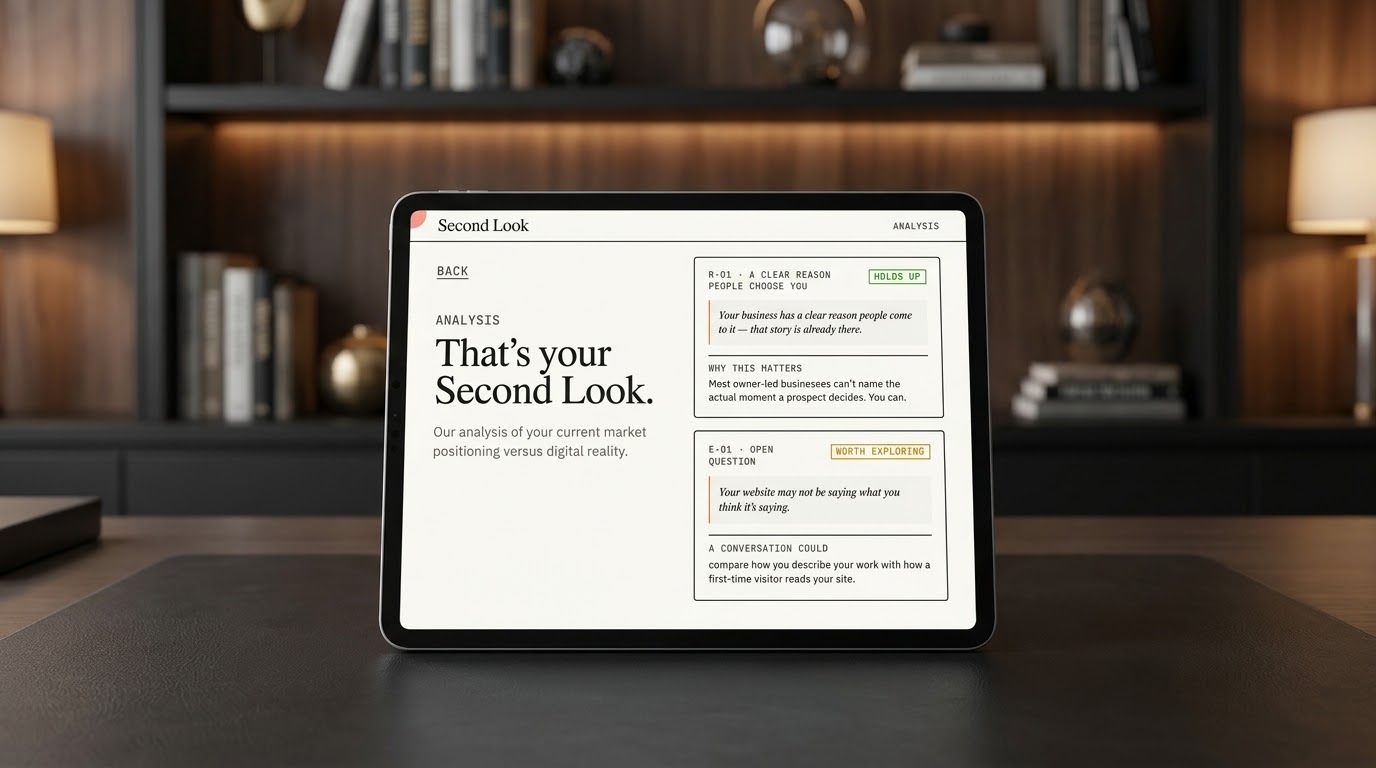
Twenty minutes. A free guided diagnostic that will show you what the world sees when it searches for your business and businesses like yours. What AI engines find, and what they don't. What holds up, and what's worth exploring. No data collected unless you choose to share it. Designed by Jean Dorff, powered by the same diagnostic thinking behind more than thirty years of strategic consulting.
Get the Second Look →