AI Strategy
What "AI Strategy" Actually Means for a Small Business
July 18, 2026


A company should not begin with the question, "What is our AI strategy?" That question, asked at the board level or handed down from the C-suite, almost always leads in the wrong direction. The better question is: what has changed for our business, in our market, our customers, our economics, or the way work gets done, and does any of that change require a response?
A company would not begin with "What is our cloud strategy?" or "What is our mobile strategy?" as a standalone question divorced from what the business is trying to achieve. AI deserves the same discipline. The technology does not define the agenda. The business does.
Sometimes AI turns out to be strategically important. Sometimes central. Sometimes mostly operational, and sometimes not worth acting on yet.
The technology does not get to set the agenda. Leadership does.
A business-integrated approach means treating AI not as a category to be managed, but as a force in the environment. It may or may not be material to a given organization at a given moment, and its implications belong in the business strategy rather than beside it.
The moment AI gets its own strategy, it usually gets its own owner, its own reporting line, and its own roadmap running beside the business rather than through it.
The organization has now decided something without deciding it. It has decided that AI is a thing to be managed next to the work, not a change woven into the work itself. The structure encodes the conclusion, and the integration question never gets asked because the org chart already answered it.
The right question belongs at the top, and it cannot be delegated without losing something essential: how does AI change what we are already trying to do, in what parts of the business, and to what extent?
Two drivers often sit underneath the rush: genuine opportunity, or the fear of missing something important. Both instincts are legitimate. Neither instinct is a strategy.
In practice, the anxiety does not look like panic. It looks like a leadership team asking for an AI roadmap before it has agreed on what problem it is solving, or someone saying, "We need to show the board what we're doing with AI." It looks like pilots launched because a competitor announced one.
Then activity becomes a substitute for judgment. A company can point to tools being tested, policies being written, people being trained, and vendors being evaluated, and still not have answered what has actually changed for the business.
Each department should think through how AI touches its work. Marketing, operations, HR. Functional AI plans make sense, and that is not the issue.
The issue lives one layer above. Who synthesizes all of that into a board-level view? Not who owns the AI project, but who can integrate the different pieces into one management view of the whole business. If nobody can answer that clearly, you do not have an AI problem, you have a structural gap.
Modern organizations divide responsibility because they have to. Technology sees technology, legal sees risk, finance sees economics, marketing sees customers. Strategy requires somebody to integrate those recommendations into a view of the whole, and that is where the gap usually appears.
The board must decide in a difficult environment. Everyone has an opinion about AI, the topic carries enormous organizational energy, and employees are actively trying to understand what it means for their roles and careers.
So the room starts borrowing confidence. From competitors, from analysts, from its own anxiety, from the latest conference. Borrowed confidence is not a substitute for an internal point of view. It only feels like one.
One useful way to test the organization's actual starting point is to ask the same question across levels and functions: do I understand where AI could materially affect my work, and where it currently does not?
That question, asked everywhere at once, gives leadership something no consultant report can. An honest organizational read of where the knowledge gaps are, where the energy is concentrated, and where someone is making consequential decisions without enough understanding to make them well.
Most people want to engage on this. They have opinions, they are curious, some are anxious and some excited. The organization that taps that energy systematically has better information than the one that filters it through a single owner.
Doing nothing can be the right decision. A leadership team does not look asleep because it decides not to act. It looks asleep when it cannot explain why.
There is a version of restraint that holds up under scrutiny. Management can say: we have examined the market, our customers, our competitors, our workforce, and the economics. We do not see a case for major action today. Here are the signals we are watching, and here is what would cause us to reconsider.
That is not passivity. That is governance. The purpose of the conversation is not to create urgency, it is to create enough clarity that management can act, or not act, without borrowing its confidence from the noise around it.
I have spent thirty years working alongside leadership teams navigating technology waves. I have watched this play out with enterprise software, with the shift to digital, and with mobile. The technology changes, and the institutional pressure to perform a response repeats with remarkable consistency.
What separates the team that can hold "we don't know yet" from the one that cannot is not intelligence, and not experience. It is whether the team has a shared standard for what counts as a good decision when certainty is unavailable.
The stronger teams are clear about three things: what they are responsible for, what evidence they trust, and what would cause them to change their mind. They can say we do not know yet, but we know what we are trying to understand.
Good judgment is not the ability to be certain early. It is the ability to remain coherent while the answer is still forming.
Jean Dorff calls this structured uncertainty, the capacity to remain coherent and governable while the answer is still forming. It is not a soft skill. It is a management discipline.
Organizations are built for action, not for uncertainty. Budgets go to initiatives, progress reports through milestones, boards ask what has been done, and performance reviews emphasize execution. All of that is useful once the problem is understood.
Before that point, the same systems create pressure. An unresolved question has no milestone, and a period of observation does not look like progress. There is a personal incentive too, because an executive can defend launching something far more easily than deciding to wait.
AI is not the cause, it is exposing the problem clearly, because the pressure to have a position is unusually high right now. McKinsey's 2025 State of AI report found that 88% of respondents said their organizations regularly use AI in at least one business function, yet only about 6% met McKinsey's definition of "AI high performers", reporting both significant value from AI and more than 5% EBIT impact attributable to it.
6%
of organizations qualify as AI high performers, against 88% reporting regular AI use (McKinsey, 2025)
Before approving another AI initiative, ask the room one question and do not let the conversation move on too quickly: what has actually changed for our business that makes this necessary?
Then ask for evidence. What changed in customer behavior, in competitor behavior, in cost, speed, quality, risk, or workforce behavior. And what has not changed. Teams are good at collecting evidence of movement, and less comfortable documenting where the impact is still weak or irrelevant.
Then ask one more thing: who has the overview? Not who owns the AI project, but who can integrate the different pieces into one management view. If nobody can answer that clearly, do not rush into another roadmap. Create that overview first.
The C-level question is not "what is our AI strategy?" It is how AI changes what we are trying to do, in what parts of the business, and to what extent. That question requires integration, not delegation.
The most important action on Monday morning may not be launching something. It may be legitimizing the fact that the leadership team is still forming a judgment. That is not delay. That is leadership doing its job before the machinery of execution takes over.
Jean Dorff is the founder of Jean Dorff Consultancy. He works with organizations and senior leaders on business strategy, management judgment, and the implications of AI for how businesses compete and operate. His perspective is grounded in more than thirty years of strategy and management experience across Europe, Asia, and the United States.
This article is last updated September 15, 2026
Frequently asked questions
No. Most companies need a business strategy that accounts for AI. A separate AI strategy tends to create a parallel roadmap beside the business rather than through it, and it answers the integration question before anyone has asked it.
What has changed in our market, our customers, our competitors, our economics, and the way work gets done, which of those changes are material to us, and what should we do about them.
Yes, when it is governed. Management should be able to explain what it examined, why it sees no case for major action today, which signals it is watching, and what would cause it to reconsider.
The capacity of a leadership team to remain coherent and governable while the answer is still forming: clear about what it is responsible for, what evidence it trusts, and what would change its mind.
Related reading
AI Strategy
July 18, 2026
Findability · AI Strategy
September 7, 2026
About the author
Jean Dorff is a strategist, author, and educator with more than thirty years in business strategy, fourteen years at Malmberg (Sanoma Group) through its print-to-digital transition, and fourteen years at Texas Instruments Educational Technology as Director of Business and Product Strategy for Europe and Asia, followed by independent strategic consultancy and coaching. He writes on findability, authority building, and AI strategy from Allen, Texas. More about Jean.
Start here
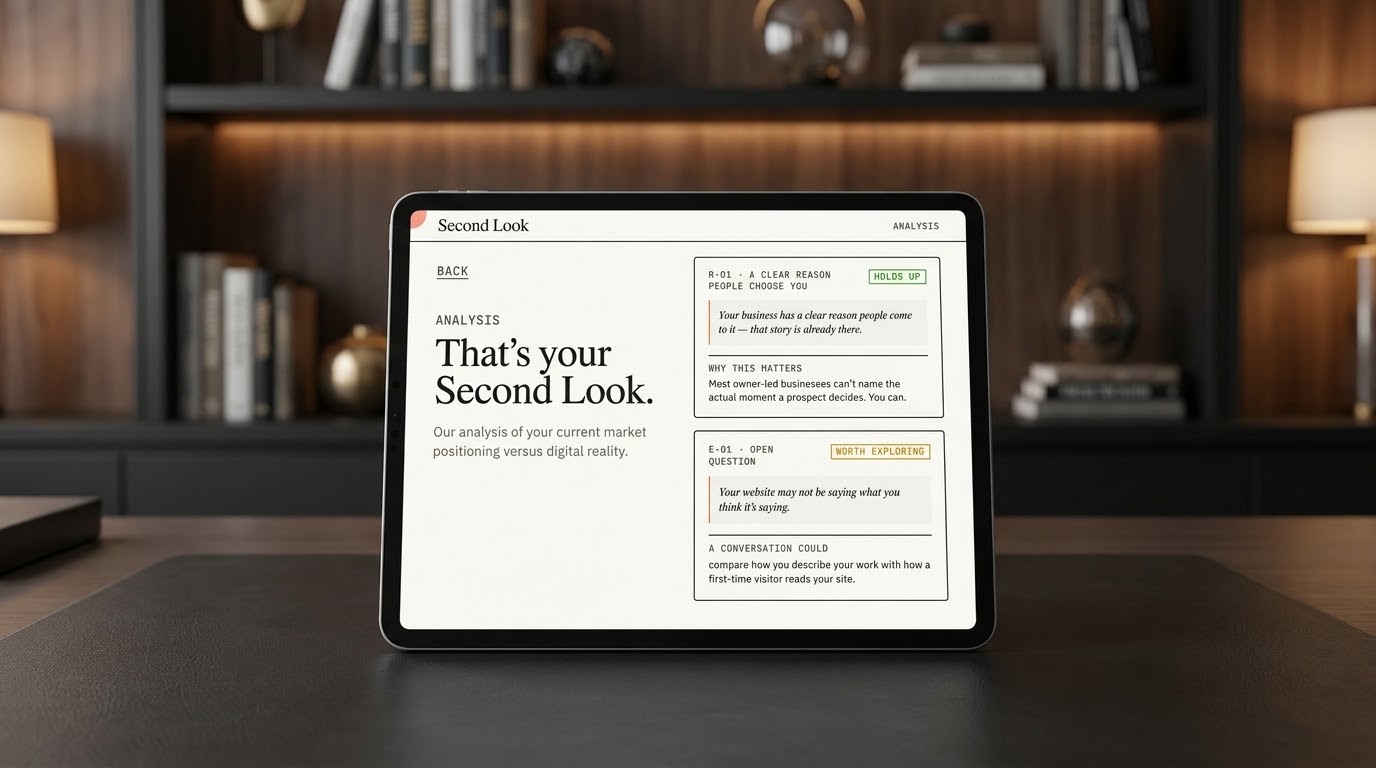
Twenty minutes. A free guided diagnostic that will show you what the world sees when it searches for your business and businesses like yours. What AI engines find, and what they don't. What holds up, and what's worth exploring. No data collected unless you choose to share it. Designed by Jean Dorff, powered by the same diagnostic thinking behind more than thirty years of strategic consulting.
Get the Second Look →