AI Strategy
Get Outside the AI Noise Long Enough to Establish Your Own Position
September 21, 2026

Most conversations about AI strategy start with the tools: which model to license, which pilot to run, which vendor to trust. That is the wrong starting point.
I start somewhere else. The more useful conversation begins with what the technology exposes. As Jean Dorff, founder of Jean Dorff Consultancy and host of AI & The Boardroom, my work sits at the intersection of AI adoption and business performance. Across that work, one observation keeps repeating: AI holds up a mirror to strategy, organization, and leadership habits that existed long before the first license was purchased.
The technology does not create the weaknesses. It makes them visible, and expensive to ignore.
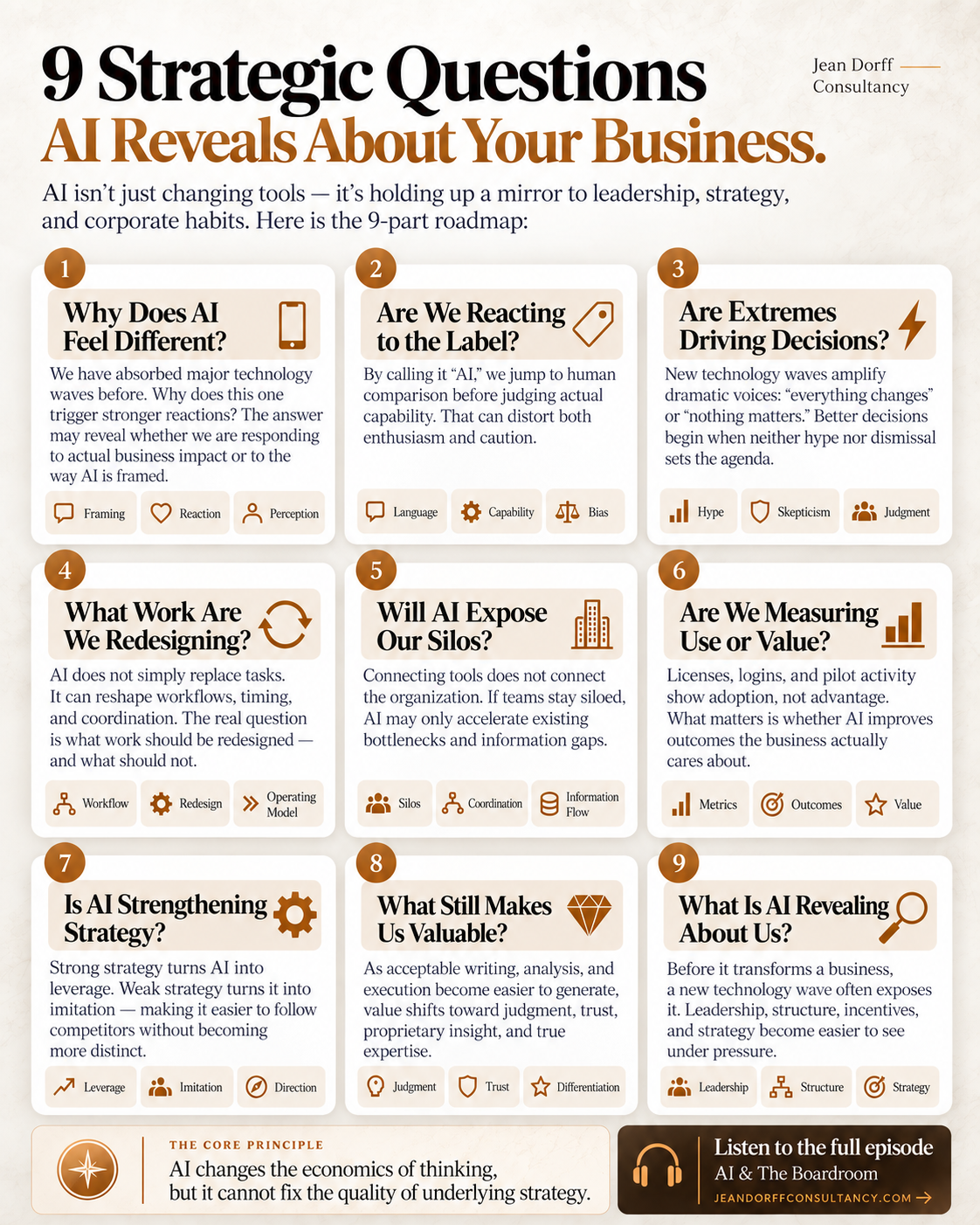
Nine strategic questions I explored on a recent AI & The Boardroom episode treat AI as a diagnostic event rather than a deployment checklist. These questions emerged from conversations with leadership teams navigating real adoption decisions in late 2025 and into 2026, at a moment when many organizations are moving from initial experimentation toward harder questions about scale and value. The technology is in the building. The quality of what surrounds it is now the variable.
Five of those questions deserve a closer look, because they surface organizational tensions most leadership teams have quietly postponed.
The default corporate move is to point AI at existing tasks. Speed up the report. Automate the summary. Draft the email faster.
This is the first place where AI reveals more about an organization than it improves.
AI amplifies whatever process it touches. If the workflow was well designed, acceleration helps. If the workflow was built on unclear ownership, inconsistent data, and habits nobody has questioned in years, automation produces faster failure.
The evidence supports this. McKinsey's March 2025 State of AI survey found that workflow redesign ranks highest among all organizational changes correlated with EBIT impact, yet only 21% of organizations using AI had fundamentally redesigned any workflows at all. That leaves most respondents reporting no fundamental workflow redesign.
21%
of organizations using AI had fundamentally redesigned any workflows, though workflow redesign correlates most strongly with EBIT impact (McKinsey, March 2025)
The strategic question, then, sits upstream of any tool decision. Which work should be redesigned, and which work should be left alone. Answering that requires an honest map of how value actually moves through the organization, what practitioners sometimes call an organizational readiness assessment, though the term makes it sound more formal than it needs to be. The honest version is simply: do we know where this process breaks, and do we want to know?
Many companies discover they never drew that map.
This is where the strategic failure becomes most legible, and where a different body of McKinsey evidence is relevant. The March 2025 figures address what organizations are doing with AI. The question here is whether what they are doing is producing results. Adoption dashboards are everywhere. Licenses issued, logins counted, prompts per employee tracked. These numbers rise, presentations look healthy, and the board relaxes.
The measurement error is hiding in plain sight.
Usage tells you people are interacting with a tool. Value tells you the business improved. Those two facts move independently. Prompt volume can climb every quarter while customer experience stays flat, bottlenecks persist, and decisions move at the same speed they always did.
39%
of organizations report any EBIT impact attributable to AI, though 88% use it regularly in at least one business function (McKinsey, November 2025)
The gap shows up in McKinsey's November 2025 State of AI survey: 88% of organizations use AI regularly in at least one business function, yet only 39% report any EBIT impact attributable to it, and most of those say AI accounts for less than 5% of their organization's EBIT. The adoption dashboard looks green. The P&L barely moves.
IBM Institute for Business Value research, discussed in its Q4 2025 Think Circle work, found that 79% of executives reported measurable productivity gains from AI, while only 29% said they could reliably measure ROI from AI initiatives. The Think Circle itself was an executive roundtable rather than a representative survey, so the figures should be read as supporting evidence rather than definitive findings. The direction aligns with every other measurement study I have read. Activity is visible. Value is not.
When a leadership team celebrates adoption metrics, it often signals that nobody defined what AI ROI would look like in the first place. The measurement problem existed before AI arrived. AI made it expensive.
If you run a business, the test is direct. Name one outcome the business genuinely cares about, revenue quality, decision speed, customer retention, error rates, and check whether AI has moved it. If the answer requires a long explanation, the honest answer is no.
There is a distinction worth naming here, because it reframes the entire AI adoption conversation.
My working view is that strong strategy can turn AI into leverage, while weak strategy can turn AI into imitation.
AI lowers the cost of executing common moves. A company with a distinct strategy can use that speed to extend its advantage; a company without one may simply copy competitors more efficiently. Content, analysis, outreach, product iterations, all of it gets cheaper and faster, and the direction that speed takes depends entirely on the strategic clarity that precedes it.
The second path feels productive. It generates activity, output, and motion. It also erodes differentiation, because everyone else has access to the same acceleration.
Once AI becomes pervasive, it no longer gives companies an edge over rivals.
David Wingate, Barclay L. Burns, and Jay B. Barney, “Why AI Will Not Provide Sustainable Competitive Advantage,” MIT Sloan Management Review, May 2025.
That observation supports the broader proposition, not the specific mechanism. Wingate, Burns, and Barney are making a point about commoditization: when a capability is universally available, it cannot be the source of sustained advantage. This is a strategic inference supported by the direction of the literature, not a settled research finding. The strategy that directs the capability carries the weight; the capability itself, once pervasive, carries none.
I would add one qualification: AI may also help some undifferentiated firms discover new sources of differentiation rather than simply accelerating imitation. That is possible. My concern is that most organizations are not asking that question, they are executing faster without first deciding what they are trying to become distinct at.
One pattern I increasingly encounter is a ground-up approach to AI adoption: organizations crowdsource initiatives from teams and then attempt to shape them into a coherent strategy afterward. The result is often impressive adoption numbers and limited business impact, because individual projects seldom align with enterprise-level priorities.
Crowdsourced enthusiasm is a real asset. It stops being an asset the moment leadership treats it as a substitute for direction.
This question sits at the center of the framework. It is also the hardest one for a boardroom to stay with.
Acceptable writing is now easy to generate. Acceptable analysis is easy to generate. Acceptable execution across a widening range of tasks is easy to generate. The cost of producing competent work has collapsed across a wide band of functions.
When acceptable becomes abundant, acceptable stops being a business.
That is not a prediction, it is already the condition in a growing number of professional service categories.
Where I expect value to migrate, and this is a directional argument, not a settled empirical finding, is toward the things that are genuinely harder to generate at scale:
The question to sit with is not how much output AI can add. Ask which parts of your value proposition survive when your competitors produce equally polished work. What survives that test is your actual business. Everything else was packaging.
The final question ties the framework together, and it explains why I resist framing AI as a technology story. It is an organizational readiness story that happens to have a technology trigger.
Before a new technology wave transforms a business, it exposes it. Leadership quality, organizational structure, incentive design, and strategic clarity all become easier to see under pressure. Silos that were tolerable at human speed become visible bottlenecks at machine speed. Vague strategy that survived on momentum stops surviving.
The research pattern matches this reading. MIT Project NANDA's preliminary 2025 study reviewed more than 300 publicly disclosed AI initiatives, conducted structured interviews with representatives from 52 organizations, and surveyed 153 senior leaders. The report described a stark divide: only about 5% of integrated pilots in its analysis were extracting substantial value, while the large majority showed no measurable P&L impact. The authors explicitly caution that these percentages are directional, based partly on the interview sample, and should not be treated as a universal enterprise AI failure rate.
5%
of integrated AI pilots in MIT Project NANDA's 2025 analysis were extracting substantial value; the large majority showed no measurable P&L impact
The report's primary explanation is a learning gap: systems that do not retain feedback, adapt to context, or improve over time, compounded by brittle workflows and the absence of clear measurement from the outset. Those are organizational conditions, not technical ones. That conclusion is consistent with McKinsey and IBM: the technology is rarely the constraint.
Those failures tell you almost nothing about AI. They tell you a great deal about the organizations attempting it.
The whole framework, the mirror, the five questions, the distinction between leverage and imitation, compresses to one principle:
AI changes the economics of thinking, but it cannot compensate for poor underlying strategy by itself.
Cheaper analysis, faster drafts, and more abundant execution change the cost and speed of thinking. They may also improve parts of the strategic process, better scenario modeling, faster pattern recognition, more rigorous analysis. But they do not remove the need for clear objectives, trade-offs, differentiation, and judgment. A confused strategy processed faster is still a confused strategy.
The practical takeaway for leaders is quieter than most AI advice. Before the next pilot, the next license, the next vendor call, sit with the questions the technology is already asking of you: what work deserves redesign, whether your metrics track use or value, whether your strategy directs the acceleration or merely rides it, and what remains genuinely valuable when competence gets cheap. These are not questions about AI. They are questions about your business that AI has made harder to avoid.
Those answers existed before AI. The technology just made them visible.
This article is last updated September 27, 2026
Frequently asked questions
Why does AI feel different? Are we reacting to the label? Are extremes driving decisions? What work are we redesigning? Will AI expose our silos? Are we measuring use or value? Is AI strengthening strategy? What still makes us valuable? And what is AI revealing about us? Five of the nine are examined in depth in this article.
Because usage metrics track interaction, not improvement. McKinsey found 88% of organizations use AI regularly in at least one business function, yet only 39% report any EBIT impact attributable to it. Value requires defining which business outcomes AI is supposed to move before the tools are deployed.
Not by itself. Wingate, Burns, and Barney argue in MIT Sloan Management Review that once a capability is universally available, it cannot be the source of sustained advantage. Strong strategy turns AI into leverage; weak strategy turns it into faster imitation.
Business outcomes the organization genuinely cares about: revenue quality, decision speed, customer retention, error rates. If a leadership team cannot name one outcome AI has moved, the honest answer is that it has not moved any yet.
Related reading
AI Strategy
September 21, 2026
AI Strategy
September 15, 2026
AI Strategy
July 18, 2026
About the author
Jean Dorff is a strategist, author, and educator with more than thirty years in business strategy, fourteen years at Malmberg (Sanoma Group) through its print-to-digital transition, and fourteen years at Texas Instruments Educational Technology as Director of Business and Product Strategy for Europe and Asia, followed by independent strategic consultancy and coaching. He writes on findability, authority building, and AI strategy from Allen, Texas. More about Jean.
Start here
Twenty minutes. A free guided diagnostic that will show you what the world sees when it searches for your business and businesses like yours. What AI engines find, and what they don't. What holds up, and what's worth exploring. No data collected unless you choose to share it. Designed by Jean Dorff, powered by the same diagnostic thinking behind more than thirty years of strategic consulting.
Get the Second Look →