Findability · AI Strategy
The Searcher's Paradox: When Answers Arrive Before You Know the Question
October 14, 2026
Your aesthetic practice has the credentials, the outcomes, and the reviews. But if the machines your patients consult first can't read that expertise, you might as well not exist.
In this episode, Jean Dorff decodes the visibility gap that is quietly costing aesthetic practices across the United States their next patients. Drawing on comprehensive market intelligence and published research, Jean breaks down why brand recognition no longer translates to search discoverability, how AI-generated answers are replacing the click, and what independent practices can do to become not just credentialed, but citable.
From the 115% growth of AI Overviews to the GLP-1 wave creating an entirely new patient category, from schema markup as a trust signal to the structural difference between a headshot on a team page and data a machine can verify, this episode maps the mechanics that decide who gets found and who gets skipped.
00:00 — Introduction
01:30 — The paradox: superior reputation, inferior visibility
03:00 — The scale of the playing field: $21B market, 1,000 new practices a year
05:30 — The brand recognition illusion and the VIP club analogy
07:00 — Treatment-specific search behavior and the restaurant menu problem
08:30 — Semantic depth: what a search crawler actually needs
10:00 — The Google Map Pack cliff and procedure-plus-location content
11:00 — The GLP-1 pharmaceutical wave: a new patient category
13:00 — From credentialed to citable: why your About page undercuts trust
15:00 — Named clinician authorship and the E-E-A-T framework
16:30 — The AI layer and the zero-click era
18:00 — How patients now ask AI for provider recommendations
19:00 — Schema markup as a direct translator for the algorithm
20:00 — How independents win: editorial authority beats content volume
The visibility gap is not a marketing gap, it is a content structure gap between the expertise you hold and the expertise the machines can read.
Patients search by treatment and location, not by brand. A single page listing fifteen services cannot rank for any of them.
AI Overviews now appear on 48% of all U.S. searches. Zero-click searches climbed from 56% to 69% in a single year. The share of consumers using AI for recommendations jumped from 6% to 45% between 2025 and 2026.
A headshot is not structural data. Named clinician authorship with linked credentials is the minimum threshold for E-E-A-T compliance in healthcare content.
Content volume loses to editorial authority. One verified expert mention in a trusted publication outweighs hundreds of generic blog posts.
Independent practices win by out-specifying national chains, creating attributable depth that templated corporate content cannot replicate.
$21.21B
Global medical aesthetics market (2024), projected to reach $78.23B by 2033 at 15.77% CAGR
48%
Of U.S. searches now show AI Overviews, with 115% growth since March 2025
69%
Of searches are now zero-click, up from 56% in May 2024
45%
Of consumers now use AI for provider recommendations, up from 6% in 2025
40%
Increase in clicks for websites using schema markup
100%
Correlation: sites losing Google rankings for poor E-E-A-T also lost all AI citations
This episode is an analysis of search mechanics and visibility trends in the medical aesthetics sector. It is not legal advice. Practitioners should always consult their state medical board and legal teams for compliance decisions regarding how to display credentials.
Host: Jean Dorff, AI Search Authority Advisor at Jean Dorff Consultancy. Introduction and outro by Nia.
Frequently asked questions
Patients search by treatment and location, not by brand name. A single page listing fifteen services cannot rank for any of them. The gap is between the expertise you hold and the expertise machines can read, it is a content structure gap, not a marketing gap.
AI Overviews now appear on 48% of all U.S. searches, and zero-click searches climbed from 56% to 69% in a single year. AI platforms recommend only 2–3 providers per query, pulling from sources they can verify and cite. Practices without structured, citable content are excluded from these recommendations.
Schema markup translates your credentials, licenses, services, and locations into structured code that AI and search engines can directly verify. Websites using schema markup report a 40% increase in clicks, and rich results attract 58% of user clicks compared to standard listings.
Independent practices win by out-specifying national chains, creating deeply attributed, procedure-specific content tied to named clinicians with verifiable credentials. One verified expert mention in a trusted publication outweighs hundreds of generic blog posts. Editorial authority beats content volume.
Related reading
Findability · AI Strategy
October 14, 2026
Findability · AI Strategy
October 8, 2026
Findability
July 8, 2026
About the author
Jean Dorff is a strategist, author, and educator with more than thirty years in business strategy, fourteen years at Malmberg (Sanoma Group) through its print-to-digital transition, and fourteen years at Texas Instruments Educational Technology as Director of Business and Product Strategy for Europe and Asia, followed by independent strategic consultancy and coaching. He writes on findability, authority building, and AI strategy from Allen, Texas. More about Jean.
Start here
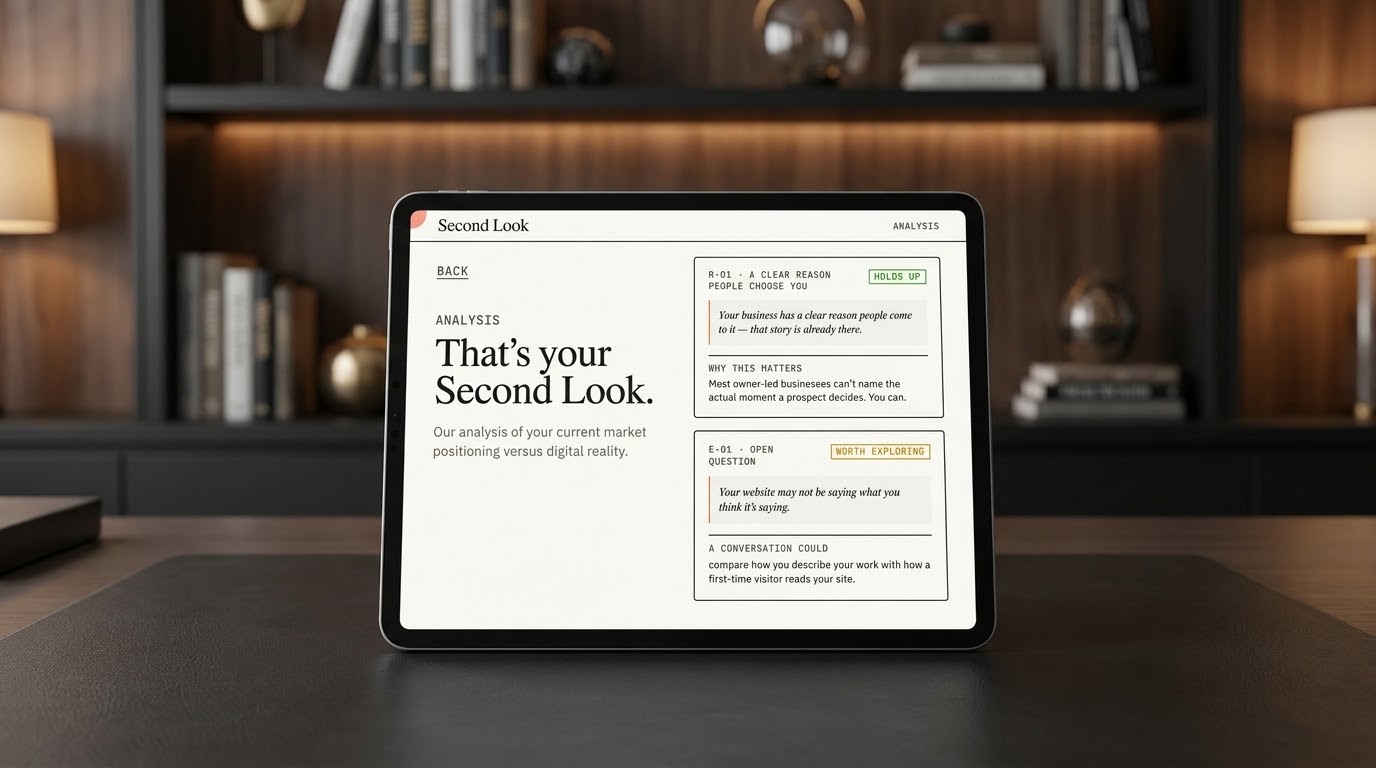
Twenty minutes. A free guided diagnostic that will show you what the world sees when it searches for your business and businesses like yours. What AI engines find, and what they don't. What holds up, and what's worth exploring. No data collected unless you choose to share it. Designed by Jean Dorff, powered by the same diagnostic thinking behind more than thirty years of strategic consulting.
Get the Second Look →