Findability · AI Strategy
AI Can Produce the Answer. Who Decides Whether It Is Good Enough?
October 8, 2026
A leadership team asks an AI system for a market positioning recommendation. Within minutes, a polished, well-structured answer arrives. It reads confidently. It uses the right vocabulary. It references trends the team has been discussing. Someone in the room says, “This is actually pretty good.” The presentation gets scheduled.
A quieter question lingers. Is this the right problem? Is our situation close enough to what this system was trained on? Do we understand what we are committing to?
No one in the room asks those questions out loud. The answer looks complete. And a complete-looking answer, in a pressured environment, tends to become a decision.
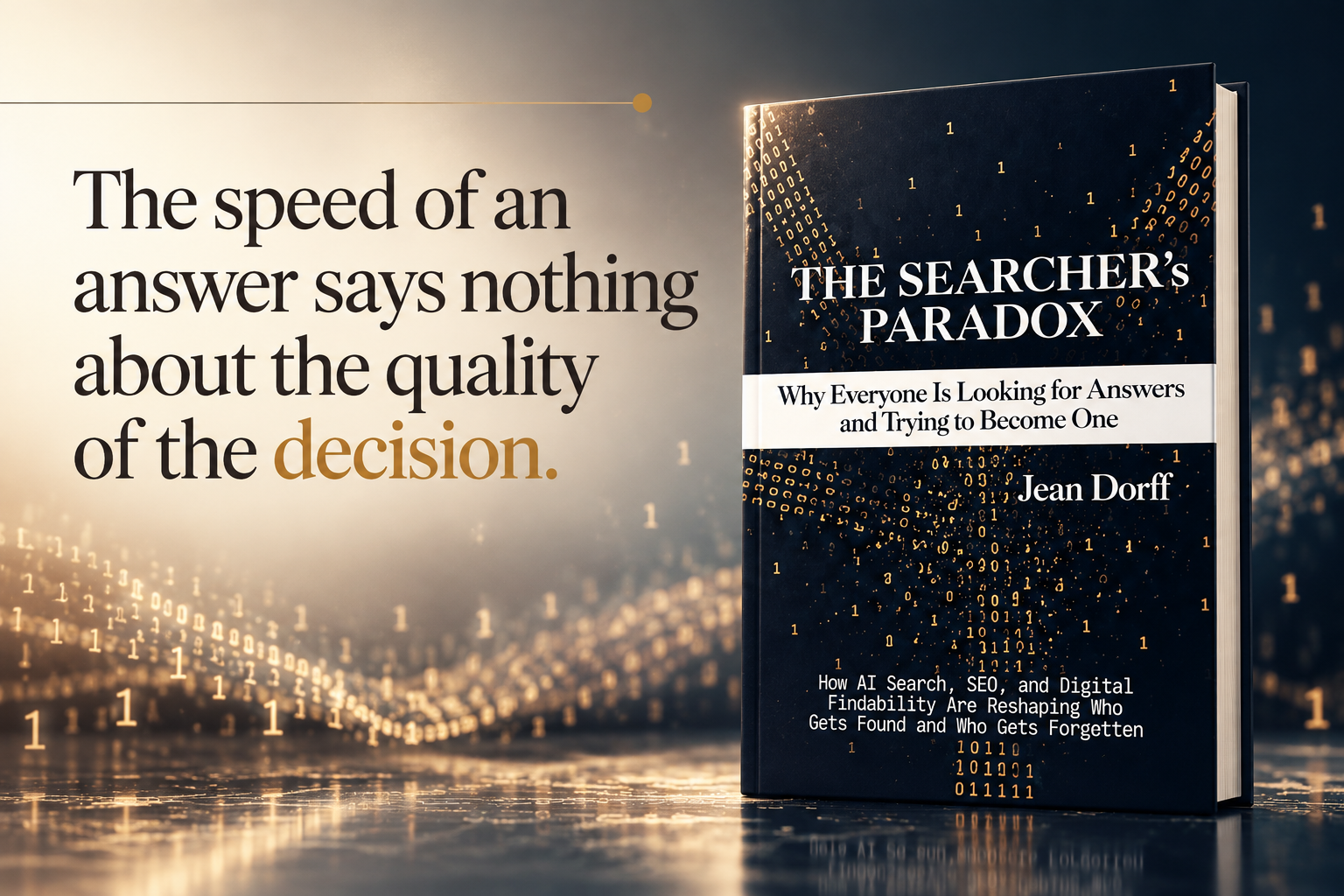
This moment sits at the center of my book, The Searcher's Paradox: Why Everyone Is Looking for Answers and Trying to Become One. The Searcher's Paradox describes a situation in which searchers, providers, and AI systems each act on an incomplete picture, while AI makes the answers passing between them look more complete than they are.
A searcher types a question, a provider publishes an answer, and an artificial intelligence system increasingly determines whether the two will ever meet, yet none of the three sees the full picture from the position in which they operate.
Three participants. Three incomplete perspectives. The searcher is looking for understanding, often before they have fully formed the question that matters. They know something is off. They know a decision is coming. The question they type into a search bar, or ask an AI, usually stands in for a deeper uncertainty they have yet to name.
The provider is a seeker-source, answering from inside the same changing world as the person asking, dependent upon the same imperfect mediators, subject to the same pressure to become visible, and vulnerable to the same temptation to confuse visibility with truth.
The provider searches too. The seeker-source, as the book puts it, “searches for the problem to which its knowledge applies, for the person prepared to use it, for evidence that strengthens or challenges it, for language that carries the meaning without distorting it, and for the boundary where its answer should stop.”
The AI intermediary, whether a search engine, a recommendation system, or a generative tool, connects the two. It works through patterns of signals and representations that are necessarily incomplete. In the book's framing, “a tool that preserves agency accepts that it is one participant in a larger search.” All three are searching. None holds the complete picture.
The distance between a question and its right answer has always existed. AI changes two things: the speed at which plausible answers arrive, and the authority they appear to carry.
8% vs 15%
Share of Google searches where users clicked a traditional result link when an AI summary appeared, versus when none did — Pew Research Center, March 2025
In a Pew Research Center analysis of 68,879 Google searches by 900 U.S. adults in March 2025, users clicked a traditional result link in 8% of visits when an AI summary appeared, compared with 15% when none did. Links inside the summaries were clicked in about 1% of visits. The data shows an association rather than proof of cause, and I would treat it that way. What it does suggest is that, for many searches, the summary is where the inquiry ends.
When an answer is polished, structured, and delivered instantly, you lose an easy way to distinguish it from an answer that has been tested, verified, and earned. The leadership teams I advise now generate AI-assisted decisions faster than they develop the criteria to judge them. Tools, vendor proposals, internal requests, and competitive pressure create an environment where the first plausible answer tends to become the committed answer.
I would describe this as a judgment problem that technology has accelerated, rather than a technology problem. A few examples I encounter regularly: leaders adopting AI tools before establishing which decisions those tools should improve; businesses investing in visibility without understanding who needs to find them, or under what circumstances; experts trying to appear relevant to every audience instead of defining where their expertise genuinely fits; executives facing a growing volume of plausible recommendations without equally strong criteria for evaluating them.
None of these weaknesses is unique to AI. AI has shifted them into a faster, riskier gear. The speed at which you can produce answers differs from the speed at which you can make sound decisions. The book treats that difference as the defining strategic problem of this moment.
The argument the book develops is that the scarce capability right now is orientation, and that better answers follow from it rather than substitute for it.
Orientation means understanding where you stand, what you are observing, and what your next move should be, even when the complete route remains out of sight. I want to be precise here, because orientation often gets mistaken for hesitation. Orientation is the capability that makes deliberate movement possible. It precedes speed and improves it.
Without orientation, activity increases while direction becomes harder to hold. An organization can become very busy without becoming better positioned. It accumulates answers without developing the judgment to evaluate them.
The book argues that orientation is what makes speed responsible rather than reckless. A decision that can be examined, tested, and corrected carries more responsibility than a confident answer presented as final. The book formalizes this as the correctable choice, with four requirements for decisions made under uncertainty: generate consequential information; limit irreversible loss; preserve options; allow course correction. Treat these as a design proposition for strategy, applicable whether the answer in front of you came from a consultant, a committee, or a machine.
One of the book's central arguments is that authority, properly understood, is bounded. Real authority includes clarity about the circumstances in which your answer belongs, and honesty about the circumstances in which it stops.
Conditional positioning: stating the problem a provider solves, the circumstances in which its method fits, and the signs that another answer may be better.
This is precision. It locates the difference clearly enough for the right person to recognize it. The principle that emerges: choose me where my answer fits.
This matters for how you present your business. The expert who can name the boundary of their knowledge earns trust faster than the expert who claims expertise everywhere. The business that tries to appear relevant to every searcher becomes legible to none of them, including, increasingly, the AI systems that determine who gets cited and who remains invisible.
A related distinction the book draws is between findability and citability. Findability means a system can locate you. Citability means a system considers you trustworthy and relevant enough to reference as a source. Traditional search visibility and AI visibility are not the same asset. Ranking well can help a system find a company, but it does not guarantee that the company will be understood, selected, or cited in an AI-generated answer. When that happens, I read it as a clarity failure rather than a technical one: the company's expertise was never structured in a way that machines, or many humans, could accurately evaluate.
I wrote The Searcher's Paradox because the distance between expertise and legibility is widening, and much of the available advice makes it worse.
The AI search industry has a strong incentive to tell you the answer is more content, better optimization, and faster adoption of the next tool. Some of that advice is useful. Much of it misses the underlying problem. You cannot optimize your way to genuine authority, and you cannot shortcut legibility. Attempting the shortcut tends to produce something generically louder rather than genuinely findable.
The book draws on thirty years of business strategy experience across Europe, Asia, and the United States, combined with an intensive effort to understand how AI search works at a structural level. It introduces several original frameworks: the seeker-source triangle, conditional positioning, the correctable choice, and the Cite-Ability Probability Meter. I built these as working tools for a landscape where being good at your work is no longer sufficient to be found by the people who need it.
The book makes no promise of a formula. It offers something I consider more useful: a clearer way of thinking about the problem, and a framework for making decisions that remain responsible even when the full picture stays out of view.
If you are a business leader, a consultant, or a marketing professional wondering why the metrics still look reasonable while the underlying dynamics feel increasingly uncertain, the argument deserves your examination.
The question the book keeps returning to is this: if every participant in the search works from an incomplete picture, what does responsible action actually look like?
Waiting until the picture completes rarely works, because it rarely completes. Responsible action means building the capacity to move, examine, and correct, and resisting the pressure that treats the first plausible answer as the final one.
That capacity begins with a question many leadership teams have yet to make room for: do we understand the problem we are actually trying to solve?
For those who want to examine the full argument, the book is available now. Leaders who recognize these questions in their own organizations are welcome to start with the Second Look, a free guided diagnostic, as a practical first step before any broader engagement. I am also available for podcast conversations, business discussions, and speaking engagements exploring these themes.
More about The Searcher's Paradox: https://jeandorffconsultancy.com/books/searchers-paradox
This article is last updated October 14, 2026
Frequently asked questions
The Searcher's Paradox is the situation in which searchers, providers, and AI systems each act on an incomplete picture, while AI makes the answers passing between them appear more complete than they are. Searchers often have yet to form the question that matters, providers search for the problem their knowledge fits, and AI intermediaries work from incomplete signals. The term comes from Jean Dorff's book The Searcher's Paradox: Why Everyone Is Looking for Answers and Trying to Become One.
Findability means a system can locate you. Citability means a system considers you trustworthy and relevant enough to reference as a source in its answer. The two can diverge: an organization can rank well in traditional search and still be absent from AI-generated answers when its expertise is described too broadly for a system to evaluate.
Conditional positioning means stating the problem you solve, the circumstances in which your method fits, and the signs that another answer may be better. The principle behind it is “choose me where my answer fits.” Clear boundaries make expertise easier to recognize, both for the right clients and for the AI systems that increasingly decide which sources get cited.
A correctable choice is a decision designed to stay responsible under uncertainty. It meets four requirements: it generates consequential information, limits irreversible loss, preserves options, and allows course correction. The framework applies whether a recommendation comes from a consultant, a committee, or an AI system.
Traditional rankings reward signals that help a search engine locate a page. AI systems that generate answers select sources they can interpret and trust for a specific question. When a business describes its expertise vaguely or tries to cover every audience, a system has little basis for citing it, whatever its ranking. Pew Research Center data from March 2025 adds a second factor: users click far fewer links when an AI summary appears, so a ranking alone now captures less attention.
Start with orientation. Ask whether the recommendation addresses the problem you actually face, whether your situation resembles the conditions the answer assumes, and what you would be committing to if you act on it. Then test the decision against the four correctable choice requirements before treating the answer as final.
Related reading
Findability · AI Strategy
October 8, 2026
AI Strategy
September 27, 2026
AI Strategy
September 21, 2026
About the author
Jean Dorff is a strategist, author, and educator with more than thirty years in business strategy, fourteen years at Malmberg (Sanoma Group) through its print-to-digital transition, and fourteen years at Texas Instruments Educational Technology as Director of Business and Product Strategy for Europe and Asia, followed by independent strategic consultancy and coaching. He writes on findability, authority building, and AI strategy from Allen, Texas. More about Jean.
Start here
Twenty minutes. A free guided diagnostic that will show you what the world sees when it searches for your business and businesses like yours. What AI engines find, and what they don't. What holds up, and what's worth exploring. No data collected unless you choose to share it. Designed by Jean Dorff, powered by the same diagnostic thinking behind more than thirty years of strategic consulting.
Get the Second Look →