Findability · Operations
The Followers Are Still There. I Just Can’t Reach Them.
November 18, 2026
This is the second article in a four-part series on digital ownership, platform dependency, and business resilience. If you missed part one, start with why findable is not the same as resilient.
I advise business owners about their digital presence. So when I examined my own, I had to ask an uncomfortable question: shouldn't I have protected it better?
The answer is yes.
A former volunteer, someone I had given administrative access to help with two of my Facebook Pages, took control of them. One was Jean Dorff Consultancy, my professional business presence. The other was The Empowering Story, the Page connected to my work with survivors of childhood sexual abuse and to my book Broken Silence. I could demonstrate the connection between both Pages, my businesses, and the domains behind them. Meta still indicated that it couldn't intervene. Years of content, relationships, and accumulated trust now sat behind permissions I no longer held.
If I'm going to speak about digital resilience, I have to include my own failure to anticipate vulnerability. Otherwise I'm just another consultant explaining risks from a comfortable distance. Authority grows from what you're prepared to examine, acknowledge, and change when your own assumptions get tested.
That experience changed how I open consulting conversations. Resilience now moves into the first meeting, before anyone proposes a tool, a platform, or a campaign. The principle behind it is one I hold across all my work: clarity before solutions.
The starting point sounds almost too simple. Know what you have. Know what you depend on. Know what happens when something stops working.
This needs to happen before you add more technology. Here's why: each individual decision makes perfect sense on its own. A new scheduling tool. An integration between your CRM and your email platform. An agency managing your ads.
Somewhere along the way, those sensible decisions create an interconnected system that nobody has stepped back to examine. The review I now run makes that system visible before we discuss anything new.
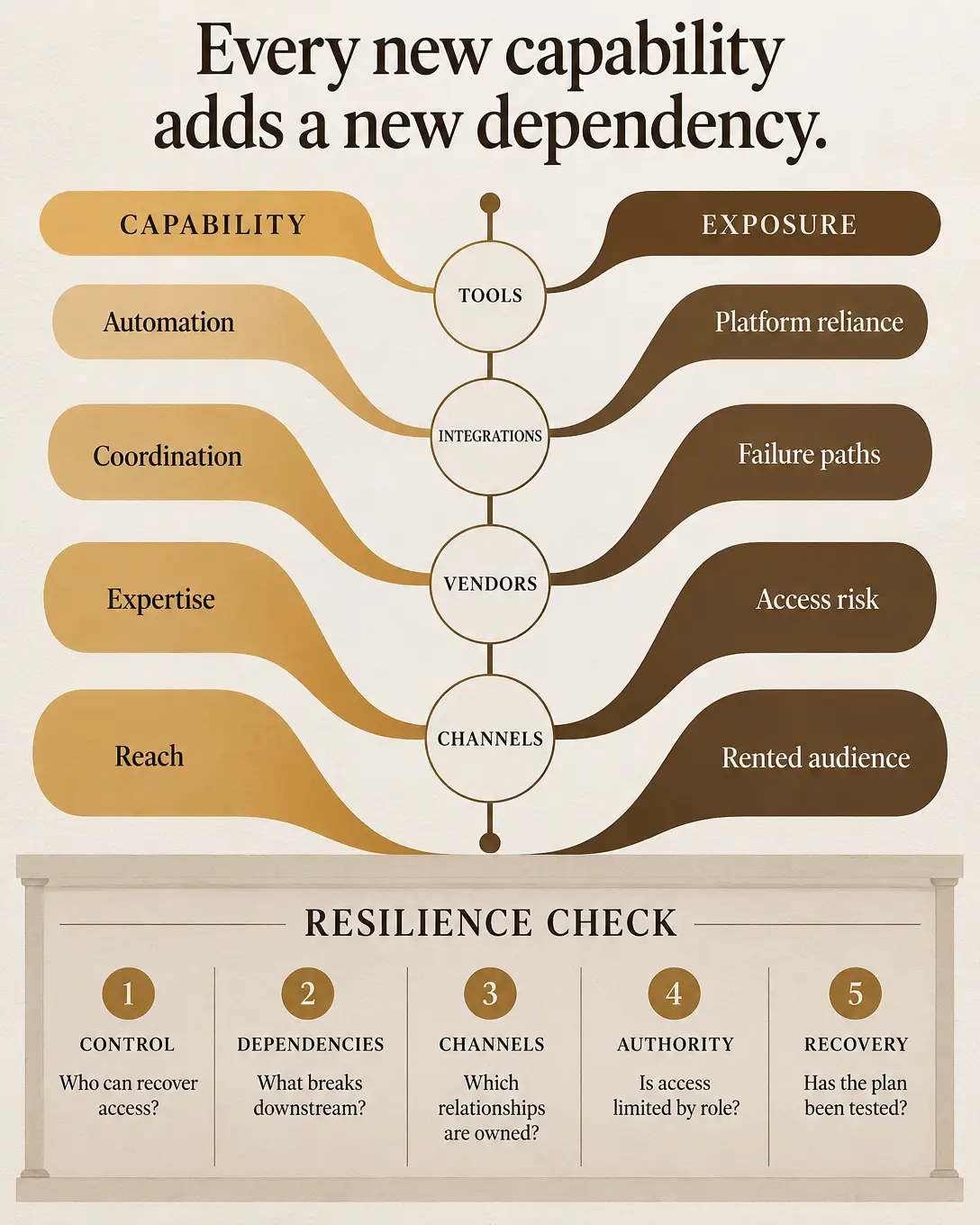
A digital resilience check is a structured review of who controls a business's digital assets, what those assets depend on, and whether the business can keep operating and communicating when one of them fails. Mine covers five areas: asset control, dependencies, relationship channels, delegated authority, and recovery.
1. Asset control. Asset control means knowing who can authorize changes, remove access, and recover each account your business relies on. Start with the basics. Who owns the domain registration? The Facebook Business Portfolio? The advertising accounts? The customer database?
I mean actual control, which goes beyond having a username and password that works today. The real test: who can remove someone else's access, and who can recover the account when something goes wrong?
2. Dependencies. A dependency is any tool, platform, or integration that another part of your business needs in order to function. Having many tools is manageable. The risk sits in failing to understand how much depends on each one.
One integration can become a single point of failure for an entire workflow. Map what breaks downstream when any one piece stops.
3. Relationship channels. Relationship channels are the routes through which people have agreed to hear from you. Social platforms lend you an audience on their terms. What you can own or control, subject to privacy obligations, is the infrastructure through which people have chosen to communicate with you:
These channels survive a platform change. Rented reach disappears with it.
4. Delegated authority. Delegated authority is the level of access you give other people, and it should match their role. Someone helping manage your social media needs the access required to perform that role. Granting the authority to change ownership or remove administrators goes well beyond that role.
Scoping access this way is responsible governance, and your team should understand it as such. Trust and structure work together here.
5. Recovery. A recovery plan states who acts, where the backups live, and where you publish an official notice when a channel fails. Skip the hundred-page document that nobody reads. Write a recovery plan you can actually run. Then test it.
There is a significant difference between believing you can recover something and knowing you can. A plan you haven't tested remains a theory.
The real issue here sits above the technology. It's business leadership.
Ownership structures, delegation rules, and recovery capability are governance decisions. Leaders make governance decisions. Delegating them entirely to a vendor or a tool means delegating accountability for the continuity of your business.
I want to be careful about framing. This check gives you no new reason for fear, and I refuse to use it to frighten business owners into buying a service. It is an exercise in orientation. You run it to see your situation clearly, decide what deserves attention, and in some cases conclude that nothing needs to change right now. A shorter list of actions can be more valuable than a longer one.
Trust allows you to collaborate, delegate, innovate, and grow. Resilience allows you to continue when something you trusted fails to work as expected. You need both, and they strengthen each other.
Growth without resilience creates a much larger business that is also much more vulnerable. Every new tool, hire, and integration adds capability and adds exposure at the same time. The check keeps those two in view together.
Start with the first question this week. Pull up your domain registration and confirm who actually controls it. That single verification tells you more about your resilience than any software purchase will.
I learned this by examining my own blind spot. You can learn it by examining yours before an incident does the examining for you.
This was part two of a four-part series on digital ownership, platform dependency, and business resilience. Part three, “Someone Took Control of My Page. Here Is What I Decided to Keep,” returns to the personal side of losing those Pages and the choices that remained after control was gone.
Jean Dorff is the founder of Jean Dorff Consultancy, where he helps business leaders examine what has changed, what has not, and what deserves action before they invest in new technology. He is the author of nine books, including Broken Silence, and the founder of The Empowering Story.
This article is last updated November 16, 2026
Frequently asked questions
Admin access lets someone manage a Page today. Ownership-level control determines who can add or remove administrators, change the business portfolio, and recover the Page when something goes wrong. I had built both of my Pages, yet once someone else held that higher level of control, having built them offered little protection.
Report it to Meta with evidence connecting the Page to your business and domain, and be prepared for the platform to decline to intervene, as it did in my case. Then communicate through the channels you still control, make your authentic channels easy to recognize, and tell people where they can find you if they choose to.
Ask what would still work if one of your essential digital channels disappeared tomorrow. Check whether your website stays accessible, whether you can contact customers who gave you permission, whether you can recover your business data, and whether daily operations continue. If you can answer each one with evidence you have actually checked, you are in a strong position.
Related reading
Findability · Operations
November 18, 2026
Findability · Operations
November 18, 2026
Operations · Findability
November 16, 2026
About the author
Jean Dorff is a strategist, author, and educator with more than thirty years in business strategy, fourteen years at Malmberg (Sanoma Group) through its print-to-digital transition, and fourteen years at Texas Instruments Educational Technology as Director of Business and Product Strategy for Europe and Asia, followed by independent strategic consultancy and coaching. He writes on findability, authority building, and AI strategy from Allen, Texas. More about Jean.
Start here
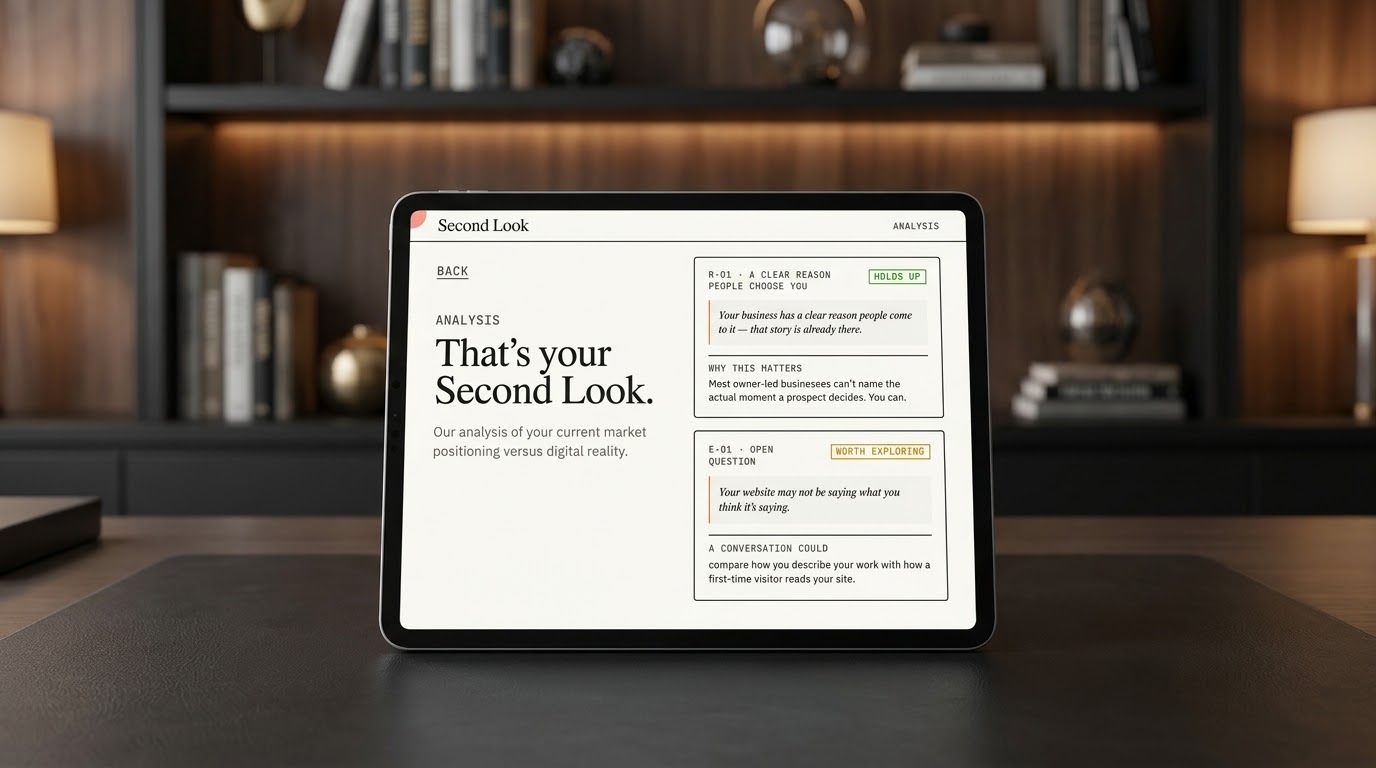
Twenty minutes. A free guided diagnostic that will show you what the world sees when it searches for your business and businesses like yours. What AI engines find, and what they don't. What holds up, and what's worth exploring. No data collected unless you choose to share it. Designed by Jean Dorff, powered by the same diagnostic thinking behind more than thirty years of strategic consulting.
Get the Second Look →